100, 103, 104 or 105? How many substances requiring preparation for accidents Korea has depends on what you count
If you handle chemicals in South Korea, or ship them to a Korean customer, you will soon meet the class "substances requiring preparation for accidents" (사고대비물질). Ask how many there are, and different sources give different numbers. None of them is wrong: they count different things.
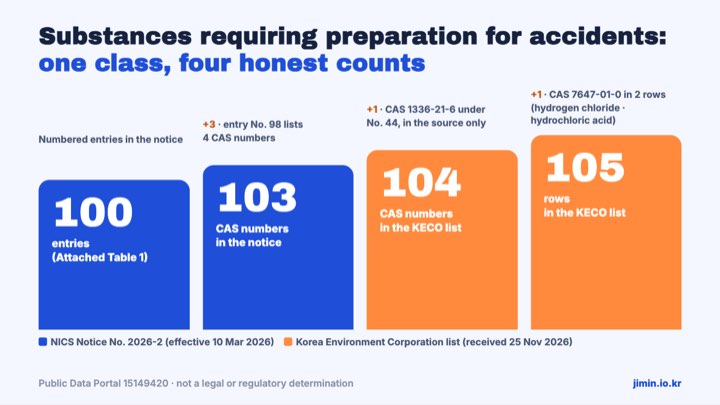
The four numbers
| Number | What is counted | Data |
|---|---|---|
| 100 | Numbered entries in Attached Table 1 of the notice | National Institute of Chemical Safety (NICS) Notice No. 2026-2, effective 10 March 2026 |
| 103 | Distinct CAS numbers written in that table | Same table |
| 105 | Rows tagged with this class in the Korea Environment Corporation list | KECO Chemical Substance Information Inquiry Service, received 25 November 2026 |
| 104 | Distinct CAS numbers in those rows | Same list |
Why the numbers differ
- 100 → 103: some entries list several CAS numbers under one number. Entry No. 98 alone has 4 (1330-20-7, 95-47-6, 106-42-3, 108-38-3).
- 103 → 104: one CAS number exists only in the government list. Under No. 44 there is a row for CAS 1336-21-6 (ammonium hydroxide), which is not in the notice's attached table. Every CAS number in the attached table also appears in the list.
- 104 → 105: the list writes one name per row, so the same CAS number can appear twice. No. 42 has CAS 7647-01-0 in 2 rows, as hydrogen chloride and as hydrochloric acid.
Older materials may show yet another number, such as 97. We could not confirm which version of the notice such a number comes from, so we do not use it as a current number.
More important than the count: the concentration
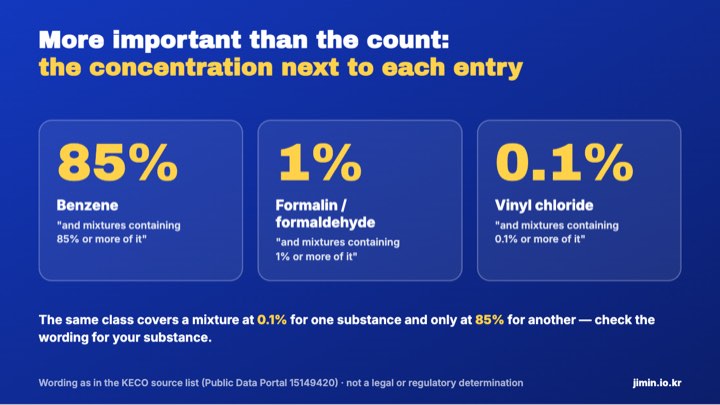
The attached table writes a concentration together with each substance, as "… and mixtures containing N% or more of it". Examples, as worded in the source list:
- Benzene: 85% or more
- Formalin or formaldehyde: 1% or more
- Vinyl chloride: 0.1% or more
The control standards for anyone handling these substances are based on Article 40 of the Chemical Substances Control Act.
So what should you check?
- Look up your substance by CAS number, not by a count or a name alone.
- Read the concentration written next to its entry and compare it with your mixture.
- If a CAS number appears only in the government list (such as 1336-21-6), check the original notice.
- When you quote a number, say which one you mean: entries in the notice, or rows in the list.
- Confirm against the original notice and the competent authority.
Sources: Korea Environment Corporation, Chemical Substance Information Inquiry Service (Public Data Portal 15149420), received 25 November 2026 · NICS Notice No. 2026-2 "Designation of Substances Requiring Preparation for Accidents", effective 10 March 2026 · Chemical Substances Control Act, Article 40. English terms follow the Korea Legislation Research Institute translation.
This counts public data and quotes the original text; it is not a legal or regulatory determination.
All four counts, with the original Korean wording:
jimin.io.kr/en/guide/accident-prep-count/