K-REACH registration grace periods by tonnage: what the law text says
If you manufacture or export to Korea an existing chemical substance, when does it have to be registered under K-REACH? The answer depends on the annual tonnage, and two of the four deadlines have already passed. Here is what the Act and its Enforcement Decree say, article by article.
The rule: register first, unless a grace period applies
Article 10(1) of the Act on the Registration and Evaluation of Chemicals (K-REACH) requires anyone who intends to manufacture or import a new chemical substance, or an existing chemical substance, of 1 tonne or more a year to register it before manufacture or import. Article 10(2) then gives existing chemical substances a registration grace period, during which they may be manufactured or imported without registration.
The four deadlines
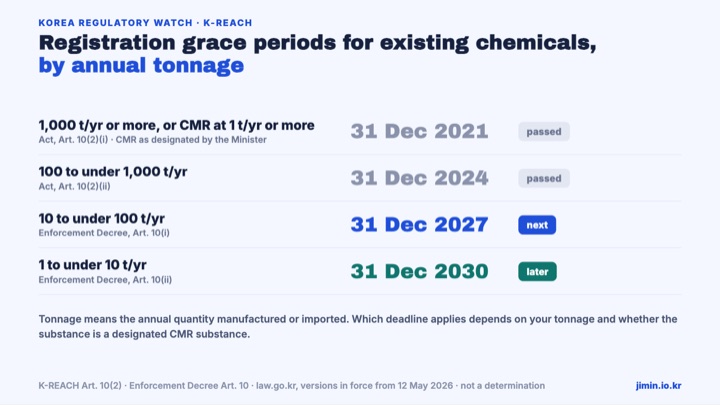
| Existing chemical substance, manufactured or imported per year | Grace period ends | Legal basis |
|---|---|---|
| 1,000 tonnes or more; or 1 tonne or more of a substance designated by the Minister as causing, or likely to cause, cancer, mutations or reproductive harm (CMR) | 31 December 2021 (passed) | Act, Article 10(2)(i) |
| 100 tonnes or more, less than 1,000 tonnes | 31 December 2024 (passed) | Act, Article 10(2)(ii) |
| 10 tonnes or more, less than 100 tonnes | 31 December 2027 | Act, Article 10(2)(iii); Enforcement Decree, Article 10(i) |
| 1 tonne or more, less than 10 tonnes | 31 December 2030 | Act, Article 10(2)(iii); Enforcement Decree, Article 10(ii) |
The Act itself sets only the first two dates. For 1 to 100 tonnes, Article 10(2)(iii) says the period is set by Presidential Decree "within the range of no later than 31 December 2030", and Article 10 of the Enforcement Decree splits it into the 2027 and 2030 deadlines above.
The grace period is not "do nothing"
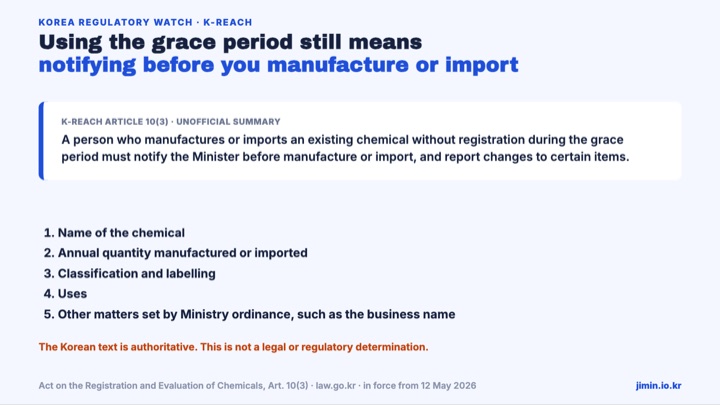
Article 10(3) says that a person who manufactures or imports an existing chemical substance without registration during the grace period must notify the Minister before manufacture or import. The notification covers the name of the chemical, the annual quantity, its classification and labelling, its uses, and other matters set by ministry ordinance. Changes to certain items must be reported again.
So what should you check?
- Confirm that your substance is an existing chemical substance, not a new one; the grace period applies only to existing substances.
- Work out the annual quantity manufactured or imported, which decides the band.
- Check whether the substance has been designated as a CMR substance; if so, the 2021 deadline applies from 1 tonne a year.
- If you rely on the grace period, check that the advance notification under Article 10(3) has been made.
- If you sell through a Korean importer, ask who files the notification and the registration.
- Confirm against the original text and the competent authority.
Source: Act on the Registration and Evaluation of Chemicals, Article 10 (in force from 12 May 2026, Act No. 21132), and its Enforcement Decree, Article 10 (in force from 12 May 2026, Presidential Decree No. 36304), read on law.go.kr on 25 and 27 November 2026. Quoted and summarised provisions are unofficial translations; the Korean text is authoritative.
This summarises the law text; it is not a legal or regulatory determination. Which deadline applies to you depends on your annual quantity and on whether the substance is a designated CMR substance.
The Act, Article 10 (in Korean):
law.go.kr — K-REACH Article 10
The Enforcement Decree, Article 10 (in Korean):
law.go.kr — Enforcement Decree Article 10
Korean chemical lists in English:
jimin.io.kr/en/chemicals/