Korea Data Lab No. 2 · "Danger" or "Warning" on a Korean label: the rule when a substance qualifies for both
If you export chemicals or mixtures to Korea, or review Korean safety data sheets, which signal word goes on the label, 위험 ("Danger") or 경고 ("Warning")? And what if a substance falls under both? A Ministry of Employment and Labor notice gives a one-line answer.
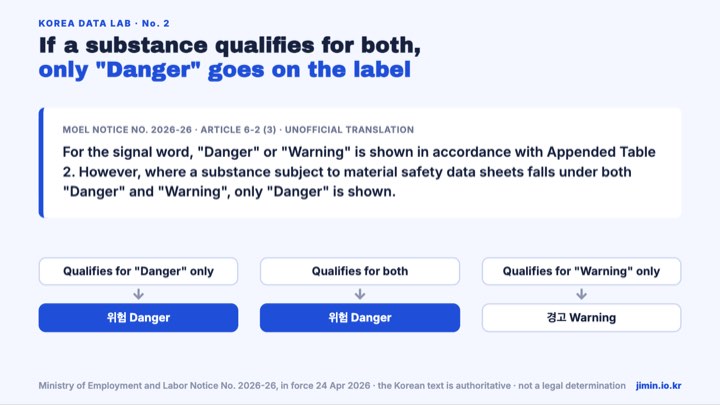
The rule: Notice No. 2026-26, Article 6-2 (3)
How signal words are used on warning labels is set by a notice under the Occupational Safety and Health Act: the Ministry of Employment and Labor Notice "Standards for the Classification and Labelling of Chemical Substances and Material Safety Data Sheets" (Notice No. 2026-26, in force from 24 April 2026). Article 6-2, paragraph 3, in our unofficial translation:
For the signal word, "Danger" (위험) or "Warning" (경고) is shown in accordance with Appended Table 2. However, where a substance subject to material safety data sheets falls under both "Danger" and "Warning", only "Danger" is shown.
Article 6 (3) of the same notice also allows only the signal word to be shown on containers for semi-finished products that hold a covered substance for the workplace's own use. In that case a warning label must be attached, or the safety data sheet posted, where workers at the storage location can easily see it.
What the Korean data shows
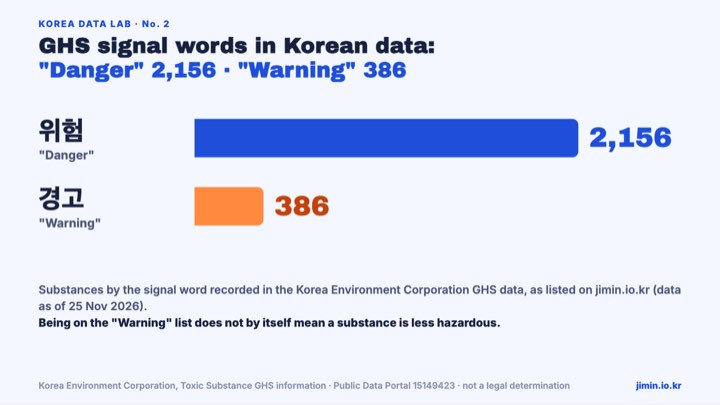
The Korea Environment Corporation's GHS data records a signal word for each substance. On our substance lists (data as of 25 November 2026):
| Signal word | Substances in the list |
|---|---|
| 위험 "Danger" | 2,156 |
| 경고 "Warning" | 386 |
Two cautions before you use these lists:
- This data comes from a different organization than the notice above. We have not confirmed that its signal words were set the same way as Article 6-2 (3).
- A substance on the "Warning" list is not, by that fact alone, less hazardous than one on the "Danger" list.
So what should you check?
- For a product label, start from the supplier's safety data sheet, not from a list.
- If the classification gives both "Danger" and "Warning" categories, the label shows only "Danger".
- Use the substance pages for the pictograms and hazard statements recorded in the source.
- Confirm against the Korean text of the notice and the competent authority.
Sources: Ministry of Government Legislation, Ministry of Employment and Labor Notice No. 2026-26, Articles 6 and 6-2 · Korea Environment Corporation, Toxic Substance GHS information inquiry service (Public Data Portal 15149423), data as of 25 November 2026. The English title of the notice and the quoted text are unofficial translations; the Korean text is authoritative.
This organizes public data and the text of a public notice; it is not a legal or regulatory determination. Check the original notice and the competent authority.
The quoted provisions and caveats:
jimin.io.kr/en/guide/ghs-signal-word/