Korea Regulatory Watch · 19 December 2026: an effective date to check if you handle chemicals in Korea
Corrected on 27 November 2026: an earlier version said all 77 rows from Notice No. 2026-16 take effect on 19 December 2026. Of those 77 rows, 40 are new designations that take effect on that date; the other rows cover substances that were already designated and are in force now. Two of the earlier examples (sodium cyanide and lead monoxide) were among those, so they have been removed.
If a substance in your product was newly designated in Korea this year, when does the designation actually apply to you? The date printed next to it in the government list is usually the day the notice was issued, not the day it takes effect. Of the 77 rows that come from this year's September notice, 40 are substances designated for the first time, and for them the date that matters is 19 December 2026. The other rows of that notice cover substances that were already designated and are in force now.
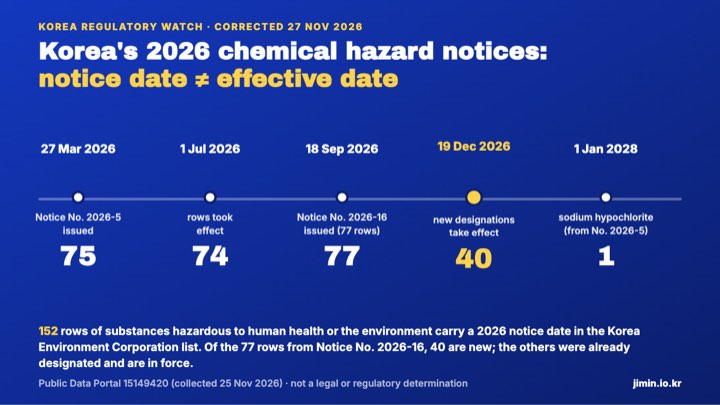
152 rows with a 2026 notice date
In the Korea Environment Corporation list, 152 rows of substances hazardous to human health or the environment carry a notice date in 2026. They come from two notices of the National Institute of Chemical Safety (NICS):
| Notice | Notice date | Rows | Effective date |
|---|---|---|---|
| NICS Notice No. 2026-5 | 27 March 2026 | 74 | 1 July 2026 (passed) |
| NICS Notice No. 2026-5 | 27 March 2026 | 1 (sodium hypochlorite) | 1 January 2028 |
| NICS Notice No. 2026-16 | 18 September 2026 | 77 (of which 40 newly designated) | 19 December 2026 for the 40 new rows; the other rows are already in force |
| Total | 152 |
Notice date is not the effective date
The notice date is the day the notice was issued. The effective date is written separately, in the "exception" field of the source or in the addenda of the notice, and it can be months later. The date column in the list is the notice date, so do not read it as the day a designation starts to apply.
What the newly designated rows look like
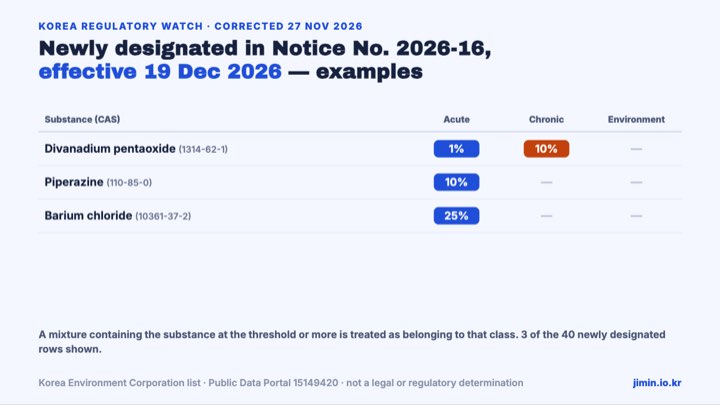
Each row carries a concentration threshold for each hazard class: acute ("Acute"), chronic ("Chronic") and environmental ("Environment"). A mixture that contains the substance at that percentage or more is treated as belonging to the same class. Examples of newly designated rows from Notice No. 2026-16, as written in the list:
- Divanadium pentaoxide (1314-62-1): Acute 1%, Chronic 10%
- Piperazine (110-85-0): Acute 10%
- Barium chloride (10361-37-2): Acute 25%
12 of the 152 rows have no CAS number in the source and are listed by their Korean name on the guide page.
So what should you check before 19 December?
- Search the 152 rows by the CAS numbers in your products.
- For rows from Notice No. 2026-16, check whether the substance is newly designated or was already designated.
- For each match, read the effective date, not the notice date.
- Compare the threshold for each hazard class with the concentration in your mixture.
- Note sodium hypochlorite separately: its date is 1 January 2028.
- Confirm against the original notice and the competent authority.
Source: Korea Environment Corporation, Chemical Substance Information Inquiry Service (Public Data Portal 15149420, scope of use "no restriction"), collected 25 November 2026. Row counts are from this list; we have not matched them one by one against the attached table of each notice. The count of 40 newly designated rows is from our substance list (jimin.io.kr/chem/list/human-hazard/, data as of 25 November 2026).
This organizes public data; it is not a legal or regulatory determination. Check the original notice and the competent authority.
All 152 rows, with thresholds and effective dates:
jimin.io.kr/en/guide/designation-timeline/